






























Boning knife/Bone cutter - Manelli
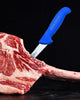
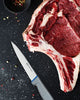
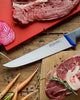
The boning knife is an essential tool in both butcher shops and professional kitchens. Its blade, slightly thicker than other knives, is specially designed to precisely separate meat from bone. But that's not all: the boning knife is also used to remove tendons and fat, particularly from poultry. Its thin, flexible blade, measuring between 12 and 18 cm, allows you to easily maneuver around bones and retrieve all the meat without damaging or wasting any. Some models feature a raised tip for even greater maneuverability.
Equip yourself now with our selection of professional kitchen knives and benefit from quality tools!
A boning knife allows you to work around the bone and remove all the meat from your cut of meat without wasting a single bite or crumbling it. A boning knife has a blade that measures 12 to 18 cm. Its blade shape is easily recognizable: thin and flexible for maximum maneuverability. Some boning knives have a raised tip. Equip yourself with our selection of kitchen knives !
Lire la suite


How to use a boning knife?
First, make sure you use a very sharp blade. A butcher's steel or a whetstone will give you a razor-sharp edge. A boning knife should never be used on bones. It's only meant for removing meat from around the bone, but its thin blade isn't designed to cut through bone; you risk breaking your knife. However, it is useful for scraping meat from the bone. You can also use it for skinning game or trimming cuts of meat.
The characteristics of a boning knife
Let's start with the blade of a boning knife. Thin and flexible, it can be more or less curved to follow the movement around the bone. It measures between 12 and 18 cm. Its HRC rating varies depending on the model, but it shouldn't be too high to allow for blade flexibility. As for materials, stainless steel is preferred for the blade because, as everyone knows, the tools of a butcher and any other food professional need to be cleaned very frequently. Therefore, choose a stainless steel blade that can be sterilized for your boning knife . Also, find a new outfit among our butcher's clothing !
Choose a butcher's boning knife for quality work! Also discover our bleeding knives! And for a complete uniform, choose butcher's trousers and a butcher's jacket !
What are the differences compared to other knives?
The boning knife differs from other butcher knives in that it has a thin, narrow, and flexible blade. Unlike a butcher's knife , designed for slicing large cuts of meat, the boning knife allows for precise work around bones. Unlike a slicing knife , its function is not to create neat, even slices but to remove meat as close to the bone as possible. It should never be used to cut directly through bones, as this will damage the blade.
What types of boning knives are there?
There are several types of boning knives :
- Straight boner : for working with the majority of meats.
- Curved boner : its raised tip follows the bone perfectly and facilitates cutting.
- Flexible boner : ideal for poultry and small game.
- Rigid boner : suitable for large cuts of meat such as beef.
Which boning knife for which use?
- Poultry and game : opt for a flexible boning knife that easily follows the joints.
- Beef and pork : a rigid boning machine will allow you to work with firmer cuts.
- Precision work : opt for a curved blade that perfectly follows the shape of the bone.
How to use a boning knife?
A boning knife should always be used with a sharp blade. Sharpen it regularly with a honing steel or whetstone for a razor-sharp edge. Use it for:
- to separate the flesh from the bone,
- remove tendons and membranes,
- trim the pieces of meat,
- to butcher game.
Warning: never use a boning knife to break or slice a bone, its thin blade could break.


